Thursday, September 14, 2006

Axioms

Guess this guy wasn't paying attention to some age-old wisdom:
A shooting victim is in critical condition this morning after being shot in a supermarket parking lot.

Witnesses told KRQE News 13 the fight broke out Monday night between a man with a samurai sword and another man who had a gun.
I'm not going to cheer the shooter for, er, shooting though, which is my usual action for self-defense shootings. The article implies that the gun-guy fled the scene, which is not kosher. Maybe he panicked after pulling the trigger, maybe he initiated the conflict, who knows at this point. In this case it's probably just two idiots who got in a fight. I will side with the old saying though:
Never. Bring. A. Knife. To. A. Gunfight.
It's just not smart and it means one of those idiots was more idiot than the other.
Yeah, yeah, I know how fast a man with a knife (or sword in this case) can move 25 feet (faster than you can clear leather, for those of you not in the know) but still. . . a guy with a gun is probably going to win when a guy with a sword attacks him.

Do people not remember the lessons of Raiders of the Lost Ark??

Filed in:

Go Wikipedia!

Wikipedia defies China's censors. Good for them:
The founder of Wikipedia, the online encyclopaedia written by its users, has defied the Chinese government by refusing to bow to censorship of politically sensitive entries.

Jimmy Wales, one of the 100 most influential people in the world according to Time magazine, challenged other internet companies, including Google, to justify their claim that they could do more good than harm by co-operating with Beijing.
[. . . ]
Wales said censorship was ' antithetical to the philosophy of Wikipedia. We occupy a position in the culture that I wish Google would take up, which is that we stand for the freedom for information, and for us to compromise I think would send very much the wrong signal: that there's no one left on the planet who's willing to say "You know what? We're not going to give up."'
I gotta say, that's a pretty cool thing to do and say. I know Wikipedia has plenty of detractors out there, but I like it; as long as you take the political topics with a massive grain of salt, check the citations of important facts, and basically understand how Wikipedia works, it's really one of the easiest, and often most accurate, information-getting tools on the web.

Of course, companies like Google and Yahoo stand to make money in Red China, whereas Wikipedia is non-profit, as far as I know, so I'm sure that's a factor. Still though, it's good that at least one of the major web tools out there is taking a stand.
Filed in:

Wednesday, September 13, 2006

More to the story

Remember the "scandalous" Scwarzenegger recording that came to light last week? In it The Governator, talking about apparently attractive Assemblywoman Bonnie Garcia, says,
They are all very hot. They have the, you know, part of the black blood in them and part of the Latino blood in them that together makes it.
Yeah, I didn't care either. Not that big of a deal, right? God knows pols have said and done far more scandolous things over the years. I mean, Garcia says she's not offended; whether that's true, who knows, but that's what she says. So it's a non-story, right? Dead in the water, who cares, move on to more important things. Not so fast, apparently:
The campaign of Gov. Arnold Schwarzenegger's Democratic rival acknowledged Tuesday that it downloaded - and leaked to the media.
[. . . ]
Cathy Calfo, campaign manager for Democrat Phil Angelides, said the campaign had done nothing wrong because the file was available publicly on the governor's Web site.
OK, so the story is a tad more interesting, but still pretty low on the scale of election-year mudflinging. Wouldn't even register a blip on the ol' radar screen without this little tidbit:
Schwarzenegger's legal affairs secretary, Andrea Lynn Hoch, said Monday that the sound files were stored "in a password-protected area of the governor's office network computer system."

Hoch said she forwarded the Internet Protocol address used to download the file to the California Highway Patrol, which is investigating how the files became public.
Wait, what? Now that's interesting. Although I don't doubt someone accidentally putting the file, or a copy, in a publicly-accessible area, it would definitely be news if it came to light that a political campaign was caught breaking into the computer system of a rival, especially if that system were owned by the State. Of course, it is possible that all this is a political smokescreen on the part of the Schwarzenegger campaign. Either way, the story has certainly taken a turn for the interesting.
Filed in:

Tuesday, September 12, 2006

"Big Oil," eh?

It seems World Controlling Satan Incarnate the big oil companies are the biggest and most controlling entities after all: they're owned by national governments.
Believe it or not, "Big Oil" is actually "Big Socialism." The Economist recently looked at the largest oil companies in the world, and found that the thirteen largest oil companies in the world are all state-owned, where all profits go to national governments. These thirteen companies control 90 percent of the world's oil. [emphasis mine]
Go figure. Next time someone makes complaints of "Big Oil" somehow destroying America or manipulating world markets for their own nefarious ends, you might want to mention Exxon barely being in the top 15 of oil companies and that National Oil Companies are often far more wasteful and corrupt than companies that live or die by competing in an open market. For example:
In Venezuela, the Ministry of Energy and Oil has only just released the 2003 edition of its annual statistical compendium on the company's performance. Its finances are certainly getting murkier: it now transfers much of its earnings directly to a development fund controlled by Mr Chávez, rather than sending them all to the central bank as it used to. [emphasis mine]
And:
Earlier this year a report in Petroleum Intelligence Weekly suggested that Kuwait's state-run Kuwait Petroleum Corporation (KPC) was not providing a full picture of how much oil it had. Even members of Kuwait's parliament complain that they do not know the true level of the country's reserves.
And yet more:
Indonesia has become a net importer of oil, despite big reserves, thanks to the failure of state-run Pertamina to develop new fields.
And what of actual profits?
The current expansion of Russia's NOCs is proving equally ill fated: costs have risen and output has grown more slowly at Yuganskneftegaz, the former production arm of Yukos, a Russian oil company, since its takeover by state-controlled Rosneft, according to Andrei Illarionov, a former adviser to the Russian government. Over the past 20 years, he points out, income per head has grown in countries with private oil industries, but has shrunk in those with nationalised ones. [emphasis mine]
The list goes on. For the other side of the coin, what happens when the NOCs have competition?
The governments of Brazil and Malaysia, among others, allow other firms to bid against their respective NOCs, Petróleo Brasileiro (Petrobras) and Petroliam Nasional (Petronas), for exploration and production rights. Since the two have better knowledge of local conditions and geology, they can still hold their own against multinationals. But the competition forces them to keep costs down and methods up to date. The presence of multinationals also helps to develop a country's pool of skilled labour and, when they operate in joint ventures, to disseminate new technology and ideas. [emphasis mine]
What is worrisome is this:
The NOCs will gradually become even more dominant as oil production dwindles in areas which are open to all comers, such as the North Sea and the Gulf of Mexico. New oil is most likely to be found in the NOCs' territory, precisely because it is largely out of bounds to multinationals such as Exxon and BP, and so has not yet been thoroughly raked over.
Which means that unless the NOCs privatize (an event for which I'm not holding my breath), the multinationals will be hurt if they don't look for new ways to profit. . . just like any other industry faced with a threatening business situation. In the short term this may mean doing things like opening the ANWR, but that's only a stopgap measure. In terms of longterm energy production, I hope they invest serious R&D money into alternative, renewable resources (such as biodiesel and ethanol-producing crops); for American oil companies, preferably alternatives of the domestically-produced variety. Not only that, but with the combination of the NOCs increasing, and already impressive, market share and the aforementioned NOC mismanagement, the possibility exists that we will face an oil industry situation that's far worse than what we have today.

All in all, it appears that Big Oil is yet another example of a free market trumping closed, state-run systems. Does the widespread ineptitude of the NOCs mean that multinationals are immune from corruption, mismanagement, and wasteful behavior? Good God, no, but in a free market, if a corporation is to survive, it must be profitable and otherwise successful even under the weight of bureaucratic momentum and board-room politics, no matter the industry. Do multinational oil companies need regulation? Yes, of course. Do multinationals, especially domestic multinationals, do all they can to skirt those regulations? Well, duh, of course they do, which means that it is our duty as voters, taxpayers, and constituents to embrace our vested interest in how our elected officials interact with not only oil companies, but with all industries and to pressure those officials incessantly to put our interests first. Regulation is needed, as is regulation reform. Let the oil companies compete, but force them to do so fairly.

After all, the "Big Oil" so many leftists and free market haters often rail against only exists with a minority market share among world oil companies, and the government-controlled entities those leftists seem to want already exist. . . and they are failing.
Filed in:

HTML, CSS, and Me

So, uh, if you notice anything weird going on with the site (other than the content; I'm talking about the structure/functionality) please drop us a comment. Tell us your browser too, as that knowledge will help pinpoint the issue(s). We really don't think there's anything wrong; we're just paranoid after the major site update a few weeks back and the browser breakage that ensued.

(exits, hands in pockets, whistling)

Filed in:

Monday, September 11, 2006

Remember

I don't want to go over the top with tributes, threats, political rhetoric from either side, platitudes, and exhortations to remember 9/11; I'm quite certain you'll hear plenty of that from friends, coworkers, the media, etc. Still though, I plan on reading some of the 2,996+ blogger tributes to the 9/11 victims and I encourage you to do the same.

We may be able to move on, to stagnate, to fight back, to surrender, to fall apart under the weight of bureaucratic and political ineptitude, or whatever else we as a country and individuals are going to do, but the victims never will.

(Exhibit from Moussaoui trial; click once for larger, twice for hi-res.)

Filed in:

Sunday, September 10, 2006

Tenorman?

Check this out:
This was an appalling crime, almost beyond contemplation in a civilised society.
Gee, you think?
Knight stabbed 44-year-old Mr Price 37 times with a butcher's knife before skinning him and hanging his hide from a meat hook in their lounge room on February 29, 2000.

She then decapitated him and put his head in a pot on the stove, baked flesh from his buttocks and cooked vegetables and gravy as side dishes to serve to Mr Price's children.
That is all kinds of screwed up. Yeah, she's a heartless, inhuman killer, but at least she's committed to being a heartless, inhuman killer. I'm totally using this as a scene in my next horror movie script. Also, notice her reason to appeal:
[Knight] had appealed against the sentence claiming the killing was not in the worst category of murder.
Um, what exactly is the worst category of murder in Australia??
Filed in:

Friday, September 08, 2006

Just shut up already

Cynthia McKinney may be considering a lawsuit against the state of Georgia regarding cross-over primary voting. Yeah, because Republicans caused all those Democratic voters in the 4th to vote for Johnson. It couldn't possibly be the fact that those voters don't want her representing her anymore! Whatever Cynthia; this tactic didn't work against Majette and it won't work now.

Let it go.
Filed in:

Friday, September 01, 2006

Is "bigot" a color?

Just when you thought the Klan couldn't get any more retarded or have more childish ideas, we find out that they're now allegedly using crayons to send their threats.
Filed in:

Thursday, August 31, 2006

Overconnected

Obviously, these people have never been to Atlanta, where this sort of bad driving wouldn't garner so much as a batted eye, much less a news article.
Filed in:

Western Exports

Looks like some of the finer things in Western society are migrating to China:
"Many parents fully support their kids getting these procedures, particularly high school kids going to university," she said. "They'll say 'It's a new environment, no one will know you. Why not enter it with confidence and a fresh, new outlook," she said, speaking after receiving a collagen injection for her lips.
Yep, they're moving closer and closer to the west every day.
Filed in:

Tuesday, August 29, 2006

Why not Giuliani?

Emotional reasons stemming from his laudable actions and leadership during and just after 9/11 notwithstanding, I've always been leery of Giuliani as a Republican Presidential candidate. Want to know why? John Hawkins at Right Wing News gives the reasons and why they matter, including such things as Giuliani's views on gay marriage (which I don't really care about, my libertarian streak showing), abortion issues (which issomewhat important to me) and on the 2nd Amendment and Illegal Immigration (which are of extreme importance to me). Really though, it's not the individual issues that matter, it's how those issues will affect a Giuliani political campaign, and Hawkins' analysis is exactly right when he says:
One of the biggest selling points for Rudy Giuliani is supposed to be that he's "electable" because a lot of independents and Democrats will vote for him. The problem with that sort of thinking is that if he becomes the Republican nominee, the very liberal mainstream media will spend nine months relentlessly savaging him in an effort to help the Democrats. Because of that, Giuliani's sky high polling numbers with non-Republicans are 100% guaranteed to drop significantly before election time rolls around in 2008.
[As] a candidate, he offers almost nothing to social conservatives, without whom a victory for George Bush in 2004 wouldn't have been possible. If the choice in 2008 comes down to a Democrat and a pro-abortion, soft on gay marriage, left-of-center candidate on social issues -- like Rudy -- you can be sure that millions of "moral values voters" will simply stay home and cost the GOP the election. [emphasis mine]
The other issue is in the South. George Bush swept every Southern state in 2000 and 2004, which is quite an impressive feat when you consider that the Democrats had Southerner Al Gore at the top of the ticket in 2000 and John Edwards as the veep in 2004. Unfortunately, a pro-abortion, soft on gay marriage, pro-gun control RINO from New York City just isn't going to be able to repeat that performance. [emphasis mine]
Also, the reason why George Bush's approval numbers have been mired in the high thirties/low forties of late is because he has lost a significant amount of Republican support, primarily because his domestic policies aren't considered conservative enough. Since that's the case, running a candidate who is several steps to Bush's left on domestic policy certainly doesn't seem like a great way to unite the base again. [emphasis mine]
In other words, Giuliani is too left for the GOP base and too right, or maybe not left enough, to please a sufficient amount of Democratic voters to make up for the voter shortfall on the Republican side. His brand of politics might be sufficient to get elected in a large metropolis in a very blue state, but it's very doubtful it will be of any help in convincing enough people to make him President. His politics certainly don't appeal to me, and only make me more worried when I wonder whom exactly the GOP will give the majority of their support. Is the GOP going to bank on moderate and fence-sitting voters in 2008, while alienating much of their conservative base? In my view, if they do so, it will be a rather large gamble, as their base is what got Bush elected in 2004. If the base stays home in 2008 because they don't see a candidate worth voting for at all, where will the GOP be then?

Under Construction. . .Complete!

Garm Howling is undergoing some further template revision and construction. If there are site errors, bear with us, we're working on it.

We're fairly certain that all functionality is back for all browsers now. . . or at least, we think it is. The new template and customizations are 99% finished; there are just a few minor items that need work, but I doubt you'll even notice them. If you do notice anything wrong, please, don't hesitate in leaving us a comment so we can fix it.

Monday, August 28, 2006

Finally switched, and it was worth it

Well, a couple of weeks ago, I finally decided that I'd had enough of Windows. Random crashes, software bloat, non-open source, WGA, security issues that never seem to be fully solved, etcetera ad nauseam have long annoyed and frustrated me, though the bloat and security issues pretty much peg my frustration meter.
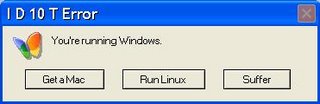
Since I decided to get away from WinXP, I basically had two other choices: get a Mac or install one of the many distributions of Linux. I don't have the money for a Mac; if I did, I'd probably be blogging somewhere somewhat more stable, albeit not free. Besides, I can't stand those condescending "Mac vs. PC" commercials that are playing all the time on TV. Also, I like cheaply building and cheaply upgrading my computers; I hate stock "anything." As for Linux. . . Well, first, let me very quickly answer the question "Why Linux?" It's fast, it's stable, it's not Microsoft, it's free, and it's far, far more secure. Yeah, that's about as quick of an explanation you're going to get right now, but you geeks out there shouldn't get mad at me; this isn't supposed to be a technical discussion/analysis. So that decision was a pretty easy one, really, but it did beg the question: Which distro of Linux to use? After all, they're numerous, varied, and without actually installing most of them, a user doesn't really know if a particular distribution is right for them.

I've played with various flavors of Linux in the past, notably Gentoo, Knoppix, and Fedora. For one reason or another, I found them all lacking in one way or another. I like playing with software and customizing OS's, but not THAT much. . . I still wanted to quickly, easily, and relatively painlessly install and use an OS and I don't want to spend hours customizing one feature. After doing some research (Distrowatch, Linux.com, Linux.org, places like that), I found Ubuntu. I have to say, I was intrigued, especially since it's # 1 on Distrowatch's "Hits per day" meter. The Ubuntu folks seem to pride themselves on ease-of-use and ease-of-install, while remaining secure, stable and easily customizable. Plus there is a fairly large and active community on their forums, which is a great help to n00bs like myself. In fact, the forums really swayed my decision, as I was able to read some great install tips and find the best software to use when the OS is installed. So my decision was made: I'd be trying out Ubuntu.

The Ubuntu .iso image (which you burn to a CD and use to install the OS) is actually for a LiveCD, which allows you to use Ubuntu within Windows, just to find out whether you like it or not. And I did like it. I liked it a lot. The pre-installed software was more-or-less what I wanted (I already use OpenOffice, so I was quite happy to see that it comes with the OS), the desktop and menubars were well organized, etc. So I decided to make the plunge and actually install Ubuntu. So I set the computer to boot off the CD and went to work. . . of which there really wasn't much. I wanted a dual-boot machine, since I want to keep WinXP for the occasions that require Windows-only software, and also for games, as I still play Counter-Strike: Source on occasion.* I also wanted one of my hard-drives readable/writeable from both Ubuntu and WinXP, mostly because of a rather large collection of mp3's (yes, Genie, they're all legal. . . really, they are), so I had to take a little more time configuring my disks than someone without those concerns might have. I won't bore you with the details of disk partitions and file system choices, but it really didn't take that long to get everything installed and set up; maybe an hour and a half total, including reinstalling WinXP, which I had to do because of the particular storage scheme I wanted.

So I've now lived and worked with Ubuntu for a couple-three weeks, and I have to say, it's pretty sweet. It automatically detected almost all my hardware, including peripherals like a webcam, printer, etc. The update/new program install software (Synaptic Package Manager) is remarkably easy to use; browse for a program that you want or need, click a button, enter your password, wait a minute, and it's done. The file system takes very little time to get used to (substitute the "Home" folder for the "My Documents" folder in your mind and you'll be ok), the OS seems faster and certainly takes up less room, though on the particular desktop machine I installed Ubuntu on, that's a negligible gain; it's a fairly powerful machine with tons of HDD storage. There are a few nit picky things I find lacking compared to WinXp, such as a media player as comprehensive and easy to use or WMP10 or iTunes, but the Linux substitutes will do.**

Overall, I was very impressed. . . impressed enough to delete XP off of my laptop and install Ubuntu there as well. Now I'm sold. It was even easier to install Ubuntu on the laptop than it was on the desktop (no dual boot) and only took about 30 minutes, plus another 15 minutes to research how to install drivers for my WifFi card and to do so, as some WiFi card manufacturers don't have any drivers for Linux and the community has to figure out how to make them. Still though, getting WiFi up and running didn't take much time at all. Now this particular laptop is a hand-me-down IBM Thinkpad T20 with only a 192MB of RAM and a rather weak PIII processor. It's somewhat outdated and definitely sluggish when running WinXP and all the anti-virus and anti-malware software that's required in this day and age. The sluggishness is almost gone after installing Ubuntu. Startup time with XP clocked in at a painfully slow 5+ minutes. With Ubuntu it takes 1 minute and 45 seconds. Out of a 20 gig HDD, XP took up almost 12 gigs, not including any software or files. Ubuntu takes up 2.6 gigs, including all software and files. Is this old workhorse of a laptop a spanking-fast, code-crunching, uber-framerate monster machine now? God no, but Ubuntu sure breathed some new life into the old girl.

Obviously, I'm pretty happy with Ubuntu, but does that mean I see it as the be-all end-all of OS's for replacing Everyman's Windows XP? No. User-familiarity issues aside, it's not quite there yet. There's still some tweaking one has to do to Linux to get it up to speed, though not nearly as much as what it took just a few years ago, or even one year ago. There are some programs and Windows-clone programs that need some work or need to be created, and there are still some hardware issues that, though there are work-arounds, still may be daunting to Joe Sixpack PC User out there. As Linux popularity increases though (and it is), more hardware and software companies will support their products being used on Linux boxes.

Is Ubuntu ready to replace my mom's WinXP? Oh my God, no! Just the thought of trying to teach her Linux sends shivers down my spine; but then she's neither interested nor does she care about how or why a PC works, so there's no failing on her part. On the other hand, Ubuntu has definitely brought Linux to the point that someone who knows how to install Windows can now install and use Linux without getting confused and frustrated, although they might need a little help from the community. If you have even a modicum of interest in getting away from the ongoing Microsoft/Windows XP hegemony, I highly recommend exploring some of the links above and giving Ubuntu a try.

Just remember folks, make a back-up of all your files before you play around.

And make 2 back-ups if you're using Windows.

*Yes, I know about the Wine program (among others) that allows you to use Windows apps within Linux; I haven't played CS:S in awhile, so I haven't tried it out yet.
**I admit it, I like Windows Media Player 10. With the right codec pack(s), it can play just about any type of media file, and I kinda like the way the library is set up.

Saturday, August 26, 2006

1/2-Ton Diesel?

I'd better put the tinfoil back on, because it appears that GM was listening to a conversation I had just last week. In that conversation, and in other conversations over the last couple of years, I lamented the facts that
A) There aren't that many diesel vehicles on American roads (percentage-wise), and more specifically,
B) The only diesel trucks being produced are in the 3/4 to 1 ton range.
Unlike European and some Asian countries, who are producing and using diesel vehicles in ever-increasing numbers, Americans haven't really embraced diesels. Why? Well, the short (very short) answer is that diesel-powered cars were eschewed for the most part by domestic makes, who instead developed gasoline-fueled engines. Because of this, there wasn't much development in diesels. Sure, a good many auto makers built diesel powered passenger cars, but with only a fraction of the R&D dollars that they put into their gas-powered cars. Thus, diesels were always viewed as being louder, bigger pollution-producers, and having less quality than a comparable gas-powered car. There was a brief surge in the consumer buying of diesels back in the '70's, during the oil embargo, but for a number of reasons (not the least of which being the fact that GM-produced diesel cars, well, broke a lot) buying quickly tapered off. Today, most Americans view diesels as only being fit for tractor-trailers and commercial-type work trucks.

Which is a shame, in my eyes.

I don't want to go off the deep end with a technical discussion of the modern diesel engine, but diesels have come a LONG way since the bad old days, as any OTR trucker or heavy-equipment contractor knows. Modern computer modules have produced superb emissions, fuel efficiency, and power numbers from equally modern diesel engines. Of course, fuel efficiency combined with power is nothing new for diesels; after all, that was Rudolph Diesel's goal when he created his eponymous engine. Diesels also tend to last longer than a comparably sized and used gasoline engine; this is due to the fewer number of moving parts in a diesel compared to a gas engine, and also the generally higher level of strength of those parts. Not only that, but there's also a burgeoning industry of providing high-level aftermarket performance parts, the leader of which seems to be Banks, who are, and have been for years, making ECM's, exhausts, and all kinds of controllers and gizmos designed to get the most out of a diesel engine. By most, I mean horsepower/torque gains measured in the 100's above stock, without doing damage to the engine, and which are literally switchable; you can get the power increase by flipping a switch, turning a knob, or pushing a button. To get the same power gains in a gas engine, one has to either seriously endanger the engine itself, spend serious amounts of money, or both. Again, I don't want to get overly technical hear, so if you'd like to know more about how diesel engines work, the first place I'd check is the Howstuffworks.com article on the subject, and go from there.

So far I've only talked about the mechanical benefits of the diesel over the gasoline engine, and I can't move on without briefly mentioning diesel fuel itself. Because of the way it's refined, diesel is less expensive than gas, which in today's market of increasing fuel prices, is a glaring benefit. Also, diesel fuel contains more energy per gallon than gas, which when combined with the higher compression ratio of the diesel engine, produces much better fuel efficiency when compared to a gasoline engine. Thus, diesel fuel is cheaper to use in two ways: inherently better energy yield and a less expensive refinement process. Oh, and did I mention that you can create diesel from plants and used vegetable oil, which can be used without (or at least, very minimally) modifying a diesel engine? Yeah, you can.

Now I need to get back to how I started this post: GM reading my mind. Obviously, I'm a fan of diesel powered vehicles, with some caveats: they must be as or more efficient than a comparable gasoline-powered vehicle, they must meet emissions standards, and they must have at least as much, if not more, power than a comparable gas vehicle. There are already a few vehicles being sold in the U.S. that meet these criteria, such as the latest Jeep Liberty and Volkswagen Jetta. Unfortunately, those don't really suit me; I want and need a truck, want because I like trucks (and I'm a little pink on the back of my neck) and need because my job often requires one. What's preventing me from just buying an F-250 or Dodge Ram 2500? Well, I don't need that MUCH of a truck, nor can I afford the hefty price tag those 3/4 ton trucks have compared to a 1/2 ton truck. Unfortunately for me, none of the pickup truck manufacturers produced a 1/2 ton diesel powered pickup truck. . . until now.

Or at least until 2010, which, as GM announced this week, is when a 360-horsepower V8 turbodiesel will make its debut in 1/2 ton, non-heavy duty trucks. Just what I've been waiting for. It's a shame that they're a few years away, but that's relatively understandable, given the increasingly stringent emissions control standards that are on the way. Some of GM's claims are pretty interesting, such as:
• GM promises the engine will use 25% less fuel than a comparable gasoline V8.
• It fits in the same engine compartment as GM's wildly successful small-block gasoline V8, which powers everything from the Chevrolet Corvette, Impala SS and Silverado full-size pickup to the Cadillac Escalade luxury SUV and Pontiac GTO muscle coupe.
• Emissions of particulates and oxides of nitrogen will be at least 90% lower than current diesels. Carbon dioxide emissions will be 13% lower than from a comparable gasoline engine.
Hmmmm. . . sounds like GM is starting to drink the diesel-flavored Kool-Aid. Granted, a diesel-powered 1/2 ton will cost more on the front end than a gas-powered 1/2 ton, but a buyer should be able to make up the additional costs (and then some) on the back end, via increased fuel-economy and better longevity.

Of course, that's assuming that GM can get quality control back up to a high level, a prospect that certainly dampens my enthusiasm. Still though. . . this sounds like exactly the vehicle I was lamenting the lack of last week. So I guess I'm somewhere in between "cautiously optimistic" and "testosterone-fueled giddiness."

We shall see.

Friday, August 25, 2006

Good Advice

Kim has sound advice and a 3-step-program for Republicans wishing to retain their seats this year and for GOP candidates planning on running in '08. . . and he does it without including oil, the War on Terror, or for that matter, any foreign policy issues!

Hie yourself there and read.

Oh, Hugo

Who needs Comedy Central when there's Hugo Chavez:
Israel often criticizes Hitler ... but they have done the same thing, perhaps even worse.
Worse than 6 million Jews killed? Huh? The mind boggles at that logic.
What has happened was a genocide.
No, what Hitler did was a genocide, what Pol Pot did was a genocide, what happened in Rwanda was a genocide, etc. What happened in Lebanon over the last month was a regional conflict arguably started by Hezbollah, an organization dedicated to the destruction of Israel. Chavez goes on to say,
Nobody should stay muted.
Especially not Chavez, as he brings nothing but unintentional, misguided humor to the entire nasty affair that is the Middle East.

Monday, August 21, 2006

CCW FTW Watson

Looks like one of those EVILLLL gun-owners did some good for his community, this time at a KFC up in Indiana:
McMiller, police said, ordered a bucket of chicken then told cashier Deanne Slaughter: “Give me the money before I shoot you.”

The suspect held his hand in his back pocket as if reaching for a gun, police said, then lifted his foot to jump over the counter.

Paul Sherlock, a customer sitting in the dining room, approached and pointed a Taurus 9-mm handgun towards the suspect’s back.

The suspect raised his hands over his head, police said. Sherlock ordered him to lean against a window with his hands up until police arrived.

Police found a long screwdriver, not a gun, in McMiller’s pocket.
Nice work Paul! Not only was he Johnny-on-the-spot, but he showed some definite restraint in NOT pulling the trigger on the armed robber. Would he have gotten in trouble if he'd shot the guy, as the guy didn't actually have a gun? Probably, but it'd be a court battle; after all, the guy was armed and did threaten to shoot an innocent. Would Sherlock have had psychological issues down the road had he put a bullet into McMiller's body? Almost definitely, unless he's one of those rare individuals with the ability to completely separate rationality from emotions.

Let me play (an admittedly biased and somewhat weak) Devil's Advocate here for a moment, though: Did Sherlock do the right thing? Should he have gotten involved at all and should he have just let events play out and let the robber go on his merry way? Well, the guy DID threaten to shoot someone in the commission of another crime, and Sherlock did have the drop on the guy, but then, should he have waited until the threat of violence was imminent; that is to say, should he have waited until McMiller actually had a weapon ready to use on the body of another person? In my view, no. Sherlock decided early on in the event to take action in order to prevent violence, when he had some degree of control over the situation. By that I mean that a firearm was not visible and not ready to use, and Sherlock was able to approach the suspect with a decent probability of doing so undetected. Therefore he had a very good chance of ending the event either without bloodshed (preferred) or with only the suspect getting hurt. Did Sherlock actually rationalize any of that? I seriously doubt it:
Sherlock told The Star today that he was acting on instinct.
Damn good instincts, I have to say. Without thinking, and, in all probability, some serious psychological and physical distractions (increased heart rate, increased blood pressure, tunnel vision, and a mind that could be either "blank" or "racing" to name a few) Sherlock did the right thing, at the right time, and did it without hurting anyone.

One final question, this one on a larger issue: Will this positive event and this responsible gun-owner garner any attention from any large media outlets, well-known pundits, or anti-gun groups? No, of course not, because no bloodshed sells fewer papers and/or advertisements than bloodshed, and besides, everybody knows that guns, by their very existence and ownership, turn their owners into unthinking killing machines.